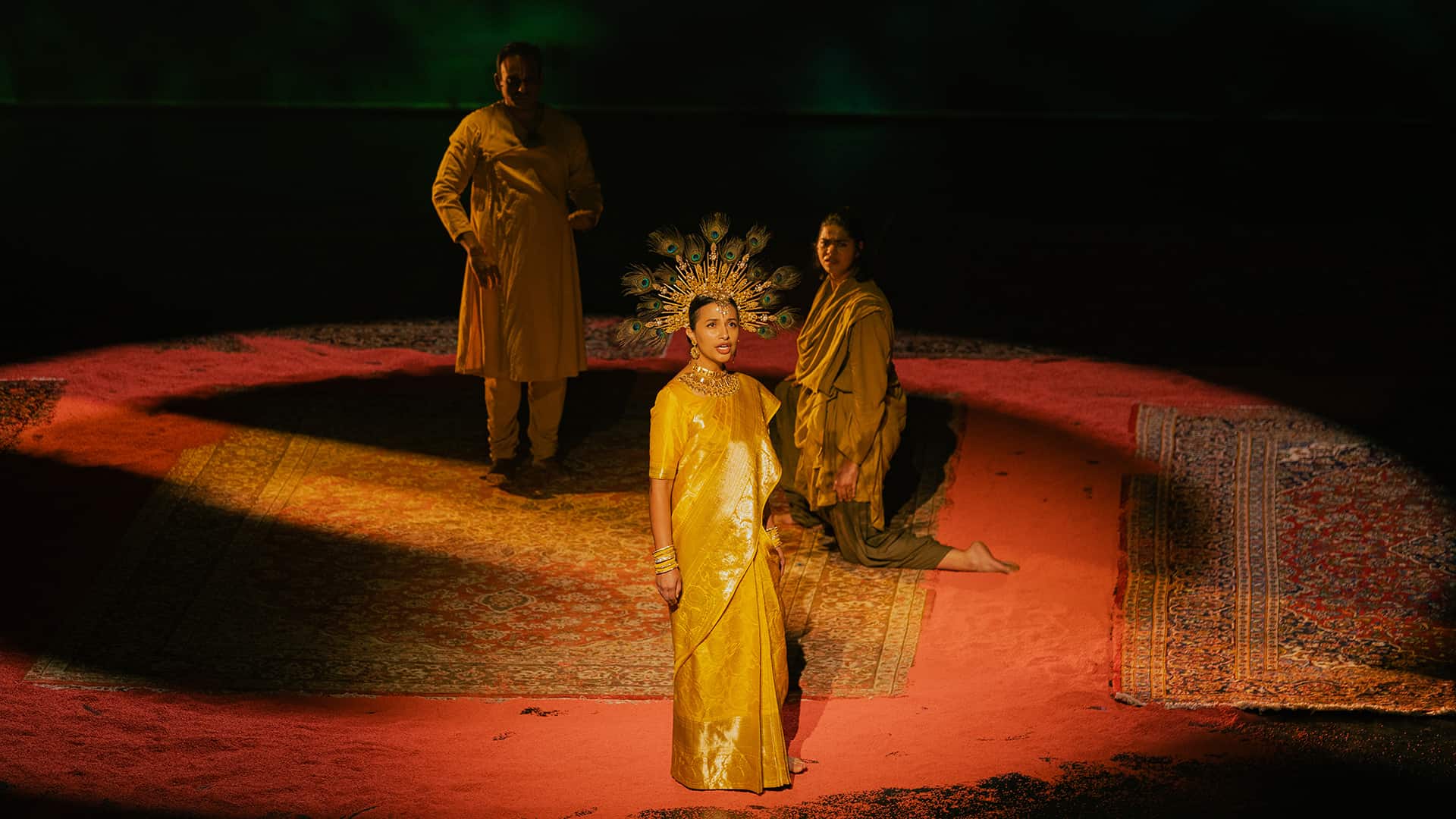
Mahabharata is not one story but, like all true epics, a compendium of stories. Across South Asia and Indonesia there are myriad performances in all sorts of theatrical traditions of individual stories from Mahabharata, but attempts to tell the whole, even of just its central, story, are rare. It is that which Miriam Fernandes and Ravi Jain have attempted in the production currently showing at the Perth Festival.
My first experience of the epic was Peter Brook’s majestic adaptation, performed in Perth and Adelaide, and elsewhere across the globe, in 1988. It is no surprise that, among many redactions, Fernandes and Jain have drawn heavily on Brook's work, even quoting it occasionally. Yet, during the eight years of preparation which have gone into their production, they have made Mahabharata completely their own.
The central story of Mahabharata is of rivalry between two branches of the same family which culminates in a disastrous war. Although mythic, it is increasingly understood that, like Homer’s Iliad, it has a historical basis, and took place in North India about 3000 years ago.
Fernandes and Jain’s version is presented in two parts, each over two hours long, entitled respectively “Karma” and “Dharma”. In the first, we see how the rivalry grew, culminating in the famous dice game after which one branch of the family, the Kauravas, sent the other, the Pandavas, into exile. In the second we see how Krishna attempted to avoid war, and, having failed, stage-managed the war so that the Pandavas won, though at the cost of the collapse of civilisation and of the entire ecosystem. It is this part that includes one of the most sacred Indian texts, the advice Krishna gave to Arjuna before the battle began, known as the Bhagavad-Gita.
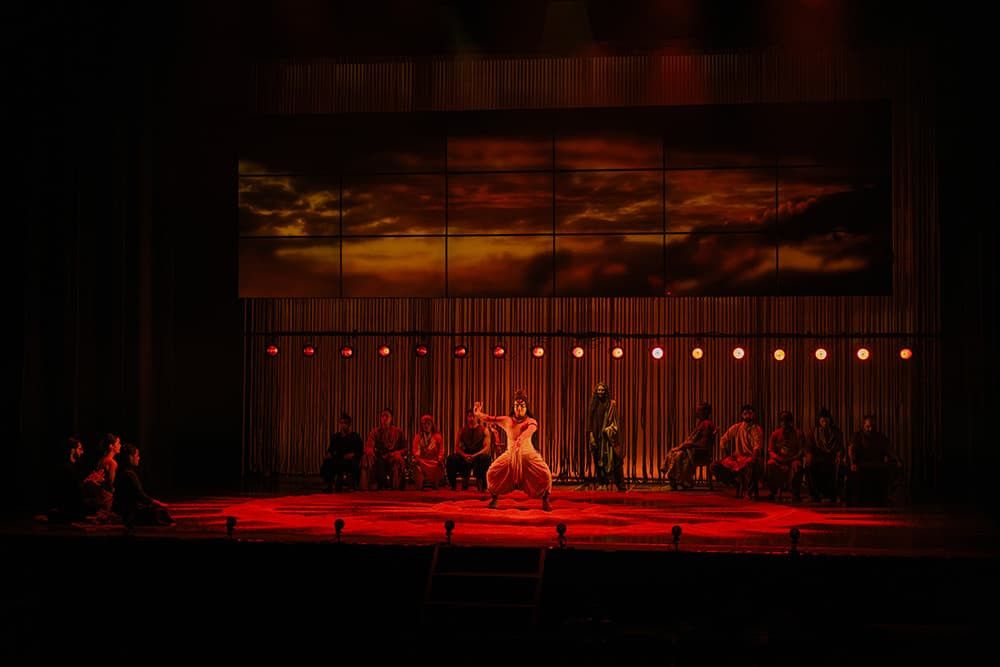
In the first part, “Karma”, the music is played and sung by six musicians who form a semicircle around the part of the stage in which the action takes place. The music they play, composed by John Gzowski and Suba Sankaran, is based on various classical Indian idioms, but especially the Carnatic style of South India. This music often underlies the spoken dialogue but never covers it.
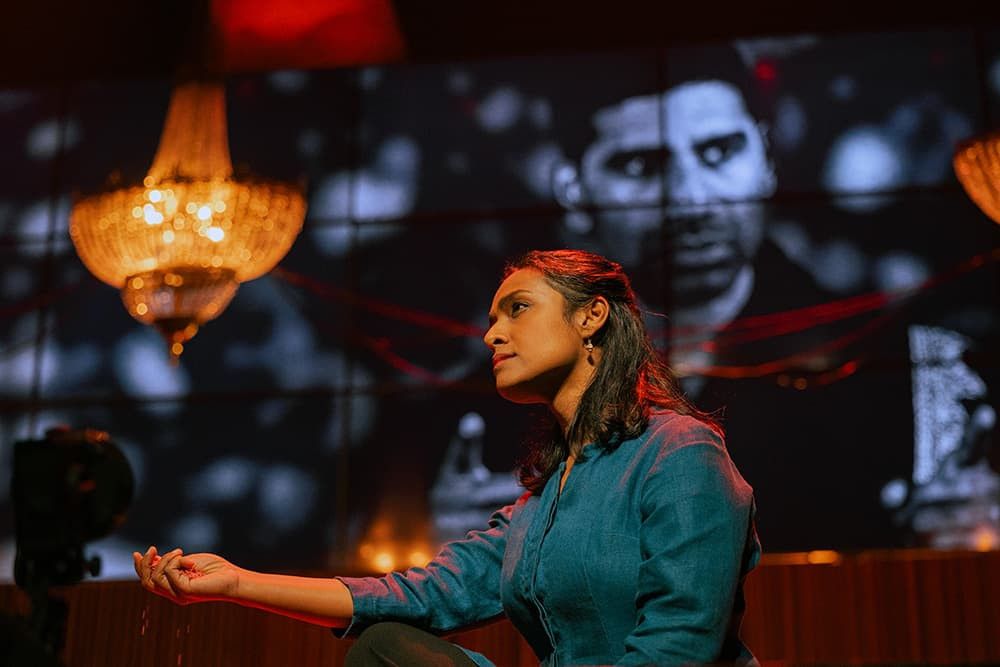
Vyasa, the sage storyteller who is credited with the authorship of the epic, narrates the story, episodes of which are enacted by the characters concerned. The actor who portrays Vyasa is herself a storyteller, in fact one of the co-authors of this production, Miriam Fernandes. Not once did the audience's attention flag in the almost three hours of “Karma” as she held the disparate threads of the drama in her masterly hands.
Peter Brook's redaction concentrated on the universal messages contained in the epic, whereas the Fernandes/Jain version draws on its equally incontrovertible Indianness. To my mind this was a great strength in “Karma”.
This first of the two parts is full of oaths, vows of vengeance, and magical boons granted by divine or semi-divine beings. These powerful utterances are the pivotal karmic moments in the action. The threads of destiny, warped by these karmic vows and boons, lead ineluctably to the climax of the dice game and the rape of Draupadi, wife of all five Pandava brothers.
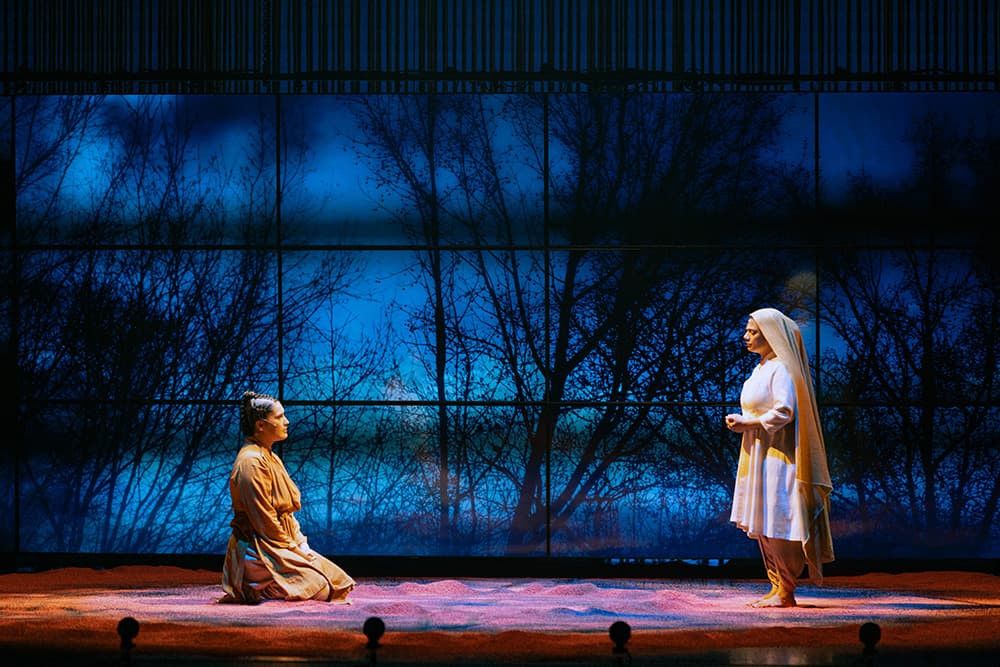
As Dushassana attempts to strip Draupadi, her sari becomes infinitely long, and she realises that, despite the awful degradation of what is happening to her, Krishna her friend is always present. The way Goldy Notay held her calm in this scene made this, for me, the most emotionally telling moment of the play.
Between Parts 1 and 2 the festival laid on a vegetarian Indian meal followed by what was described as a storytelling session. This consisted of a conversation between the two authors of the play, in which they entertainingly discussed the episode of the exile of the Pandavas which was omitted from the production. The exile includes the crucial question and answer scene in which Yudhishtira’s unswerving adherence to Dharma is most clearly shown.
This segues into Part 2, “Dharma”. This word is untranslatable in English, and I think the translation offered in the festival program, “empathy” is misleading. As I understand it, the word covers concepts including ethics, duty, truth, law, morality, compassion and many others. The central importance of this concept in India is demonstrated by the fact that the symbol in the modern Indian flag is the wheel of Dharma.
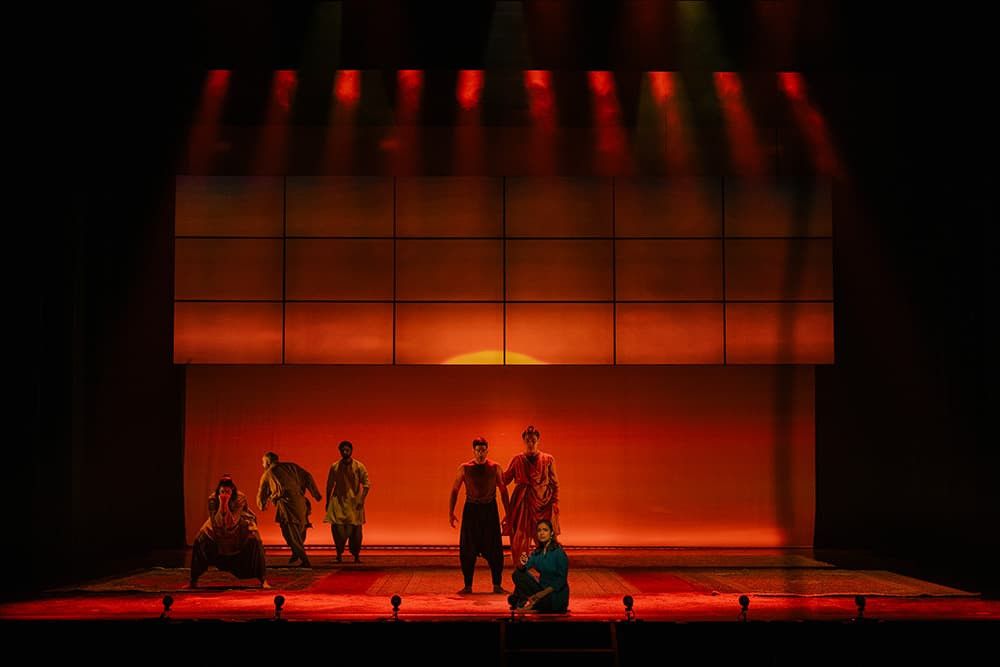
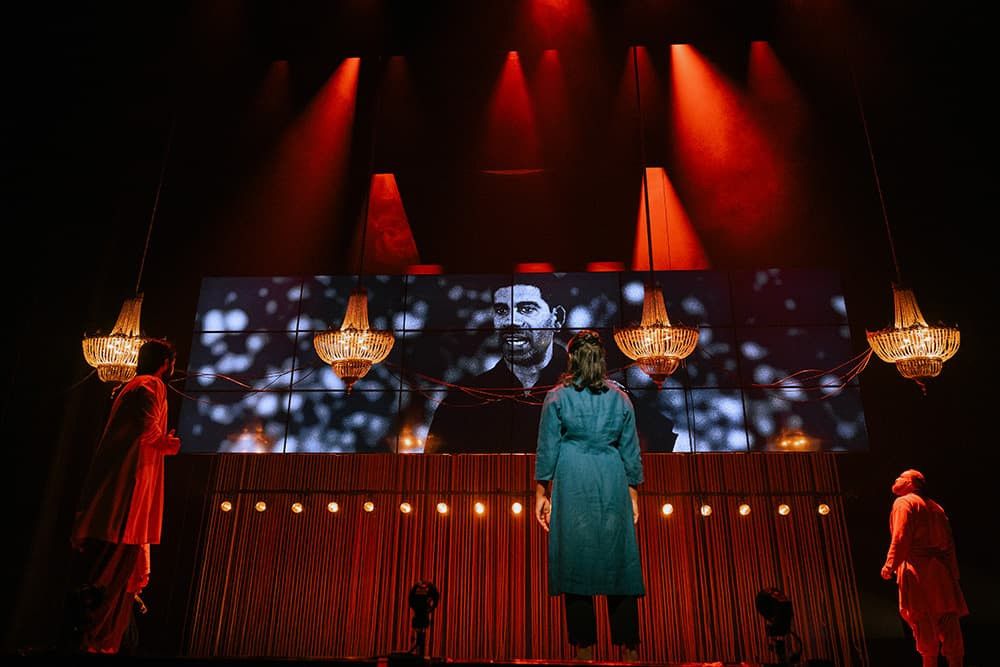
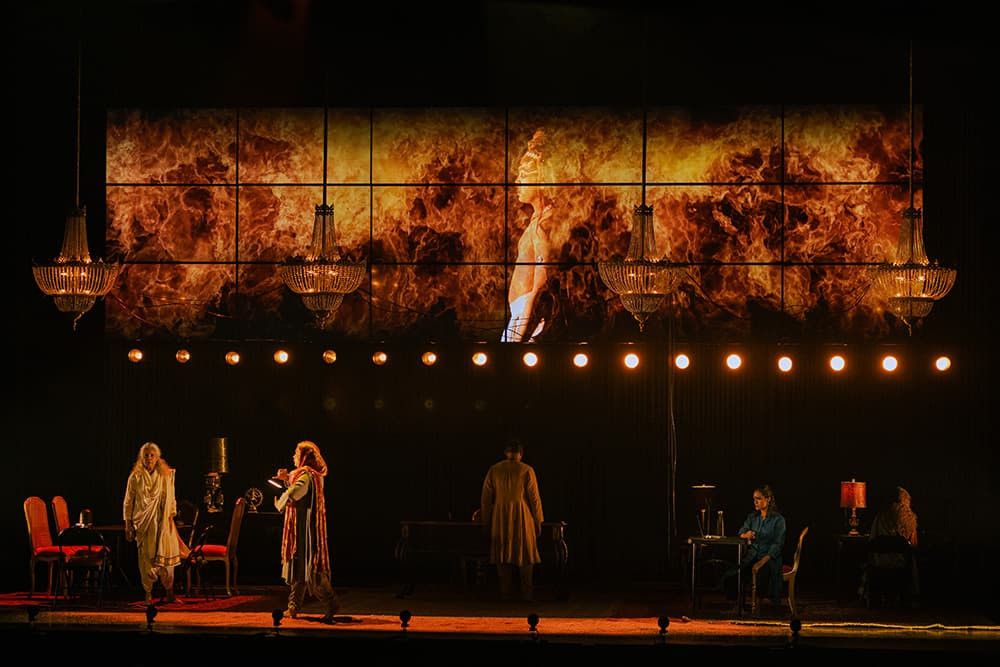
For Part 2 the theatrical modes altered. The music was no longer played by visible musicians, but by a soundtrack composed partly by those musicians, partly in imitation of Western instruments, and partly synthesised. Further, the stage was no longer bare apart from the actors, but included furniture (a table where the negotiations to avoid war took place) and digital projections on a screen above the stage. Having seen the Brisbane Ring cycle in 2023, with its fantastically sophisticated digital scenery, I confess I found these projections a bit clunky.
Another different theatrical mode was used for the Bhagavad-Gita scene, in which Krishna exhorts Arjuna to let go of his ego and do his duty as a warrior. Described as an “Opera”, this scene was sung by a Western style singer, Meher Pavri. She embodied Krishna in his divine form, and was accompanied by a soundtrack representing a Western orchestra. Pavri's singing was stunningly good, but, speaking as a composer myself, I found the actual piece a little short of the dazzlingly divine music that the scene invites. And yet there was in this endeavour a sense that this whole epic needs some very special music, in order to touch the hearts as well as the minds of Western audiences.
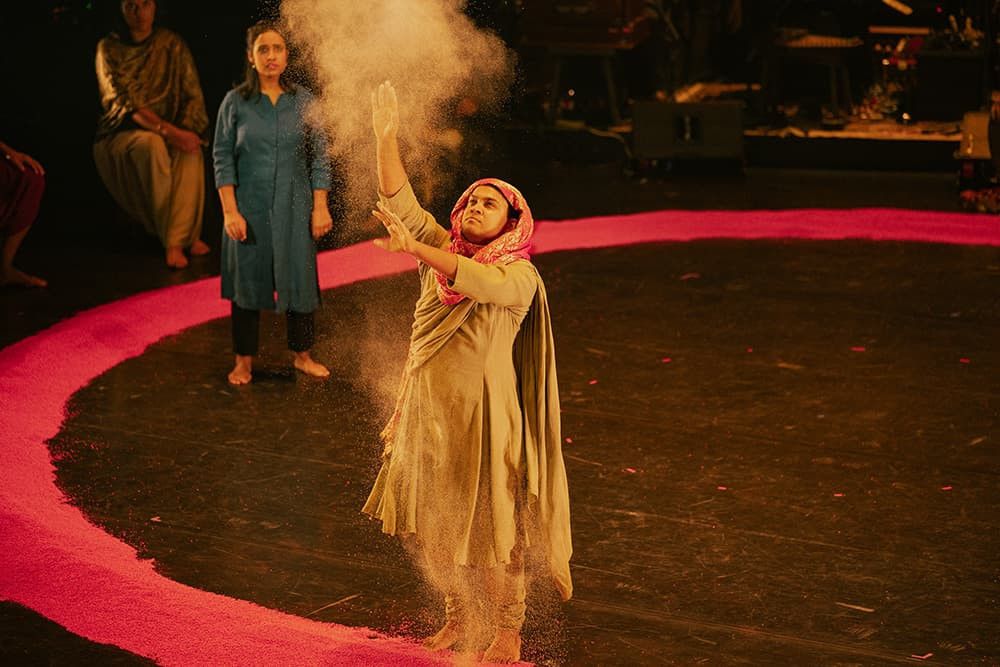
So the inevitable war starts, and Shiva, the god of destruction, dances throughout it. The dancer, Jay Emmanuel, became Shikandin, Bhishma's nemesis, and Abhimanu, Arjuna's teenage son who is destroyed by the Kauravas, and other significant protagonists of the war. This works well, but when Bhima and Duryodhana bring clumsy wooden clubs onstage for their final duel I found the clash between the literal clubs and the poetic dances of Shiva hard to handle.
Both sides in this conflict are flawed. The Kauravas are noble, yet nepotistic and scheming. Their leader, Duryodhana, superbly played by Darren Kuppan, descends, Macbeth-like, through ambition and envy into a state which is hard to distinguish from pure evil. It is no accident that some of his lines echo pronouncements by Trump, and even by some of our Australian politicians.
The Pandavas are led by Yudhishtira, the paramount upholder of Dharma, but are driven by the desire for revenge for injustices. These injustices are in part occasioned by the too fundamentalist adherence to the letter of Dharma as opposed to its spirit. Aristotle did not know Mahabharata, but if he had he would have found it a corroboration of his idea of the fatally flawed hero every bit as powerful as the Greek tragedies.
Stand-out performances included Munish Sharma as the passionate avenger of the wrongs done to Draupadi; Neil D'Souza, profound yet playful interpreter of the character of Krishna; and Ellora Patnaik who impressively portrayed both Kunti, mother of the Pandavas, and Drona, their stern guru. Yet one of the beauties of this production was that the whole was greater than the sum of its parts. Fernandes and Jain’s control of the dynamic flow of Part 1 was complete, and if Part 2 was less coherent, the changes of theatrical modes kept a constant interest.
The Perth Festival program reminded us that one needs to live with the Mahabharata for a lifetime. Almost everyone I spoke to during the intervals of the performance made a comment that we have, as a race, learnt nothing in the millenia since it was written; wars still happen because “when both sides think they are right and the other wrong, war is inevitable”. It is, nonetheless, a towering work of human endeavour, and hats off to the Festival Director Anna Reece for bringing this amazing performance to Perth.
Event details
Why Not Theatre presents
Mahabharata
written & created by Miriam Fernandes & Ravi Jain | using poetry from Carole Satyamurti’s Mahabharata: A Modern Retelling
Director Ravi Jain
Venue: His Majesty's Theatre | Hay St, Perth WA
Dates: 8 – 16 February 2025
Tickets: $49 – $99
Bookings: www.perthfestival.com.au
Part of the 2025 Perth Festival
Gallery
.jpg)